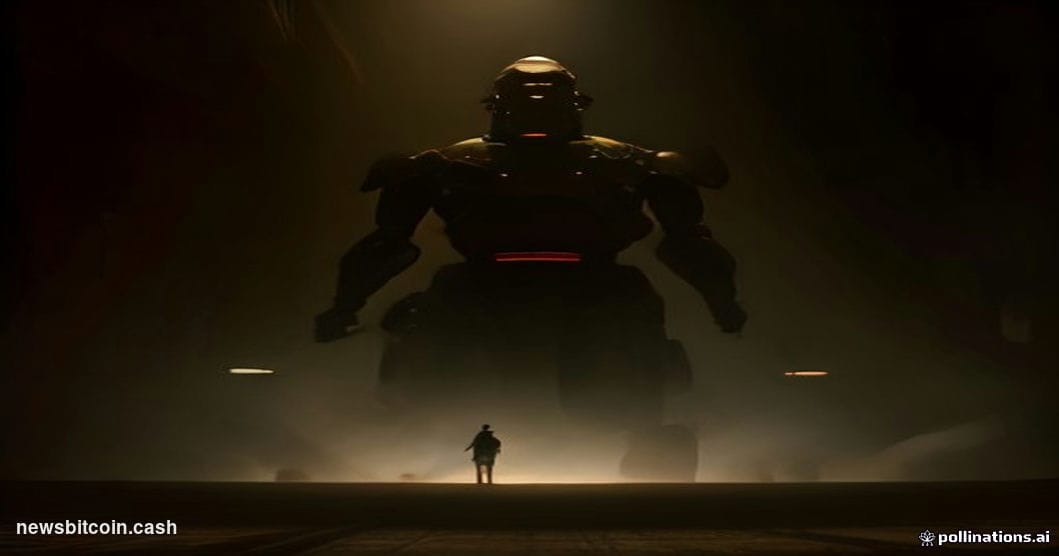
The robotics race between the United States and China just acquired a new and dramatically physical dimension. China has unveiled a humanoid robot standing 13 feet tall — nearly two and a half times the height of an average person — capable of lifting more than 1,100 pounds. Elon Musk's response was not alarm or defensiveness, but ambition: Tesla's Optimus robot, he suggested, will one day graduate from assembly-line companion to something far more extraordinary — building a real-life Optimus Prime.
The implications extend well beyond the spectacle of competing robotic giants. We are watching, in near real time, the acceleration of a technological arms race in physical artificial intelligence — autonomous machines capable of operating in and reshaping the physical world. The question for anyone tracking the intersection of advanced technology and decentralized digital infrastructure is no longer whether humanoid robotics will become a dominant industrial force, but how quickly, and who will own that future.
China's Hardware Statement
China's 13-foot humanoid robot is not a concept render or a trade-show promise. It is a functioning machine with the documented ability to lift over 1,100 pounds — a figure that dwarfs the payload capacities of virtually every Western humanoid robot currently in public deployment. That number matters. Industrial utility in sectors like construction, mining, logistics, and heavy manufacturing is gated almost entirely by force and payload capability. A robot that can move more than half a metric ton changes the calculus of what autonomous machines can actually replace in the physical economy.
China has been methodical in its approach to robotics, treating it as a strategic national priority in much the same way it approached electric vehicles, semiconductors, and solar manufacturing. The unveiling of a machine at this scale is not a surprise to those who have been watching Beijing's industrial policy pipeline — but its sheer physical presence sends a message that transcends policy papers and five-year plans. This is a demonstration of manufacturing ambition made flesh and steel.
Musk's Counterpunch: Optimus Building Optimus Prime
Musk's reaction to the Chinese unveiling was characteristically theatrical but also strategically meaningful. His tease — that Tesla's Optimus will one day be responsible for constructing something on the scale of an "Optimus Prime" — is less a product roadmap item and more a philosophical declaration. It positions Tesla's approach to robotics as recursive and self-reinforcing: smaller, dexterous humanoid robots manufacturing larger, more powerful ones. It is a vision of machine-driven production that removes the human bottleneck from the scaling process entirely.
Tesla's current Optimus units are designed for human-scale environments, capable of performing tasks in factories and warehouses optimized for people. They are nimble, sensor-rich, and increasingly capable — but they are not lifting 1,100 pounds. Musk's framing suggests he is less interested in competing directly with China's brute-force approach and more focused on a longer arc: building the robotic workforce that eventually produces the next generation of machines. Whether that is genuine strategic thinking or a deflection from a capability gap is a question the market will answer over the next several years.
Why the Crypto and Digital Asset World Should Be Paying Attention
The connection between physical robotics and the digital asset ecosystem is not immediately obvious, but it is real and growing. Decentralized networks, tokenized infrastructure, and Ethereum-based smart contract systems are increasingly being discussed as the coordination and ownership layer for autonomous machine economies. If robots are building robots, and those robots are operating factories and supply chains, the question of how value, ownership, and output are recorded and distributed becomes urgent.
Several projects in the decentralized finance space are already exploring machine-to-machine payment rails, tokenized physical assets, and autonomous economic agents. The emergence of physically capable humanoid robots at industrial scale — whether from Chinese state-backed programs or Tesla's commercial pipeline — compresses the timeline for these use cases from speculative to near-term. The infrastructure being built today on public blockchains may very well become the settlement layer for an economy where the primary producers of goods are not human workers but autonomous machines.
China's 13-foot robot and Musk's Optimus Prime dream are separated by philosophy, scale, and national interest — but they share a common endpoint: a world where physical labor is increasingly mechanized at a level that restructures every assumption about economic production. For digital asset infrastructure builders, that world is not a distant hypothetical. It is an engineering brief arriving faster than most anticipated.
What happens in the next two to three years — in terms of robot capability benchmarks, national deployment programs, and the policy frameworks that govern machine ownership and output — will define whether the West's bet on decentralized, software-first robotics can close the gap with China's hardware-first, state-backed momentum. The 1,100-pound lift is not just a technical specification. It is a geopolitical signal.
Written by the editorial team — independent journalism powered by Bitcoin News.