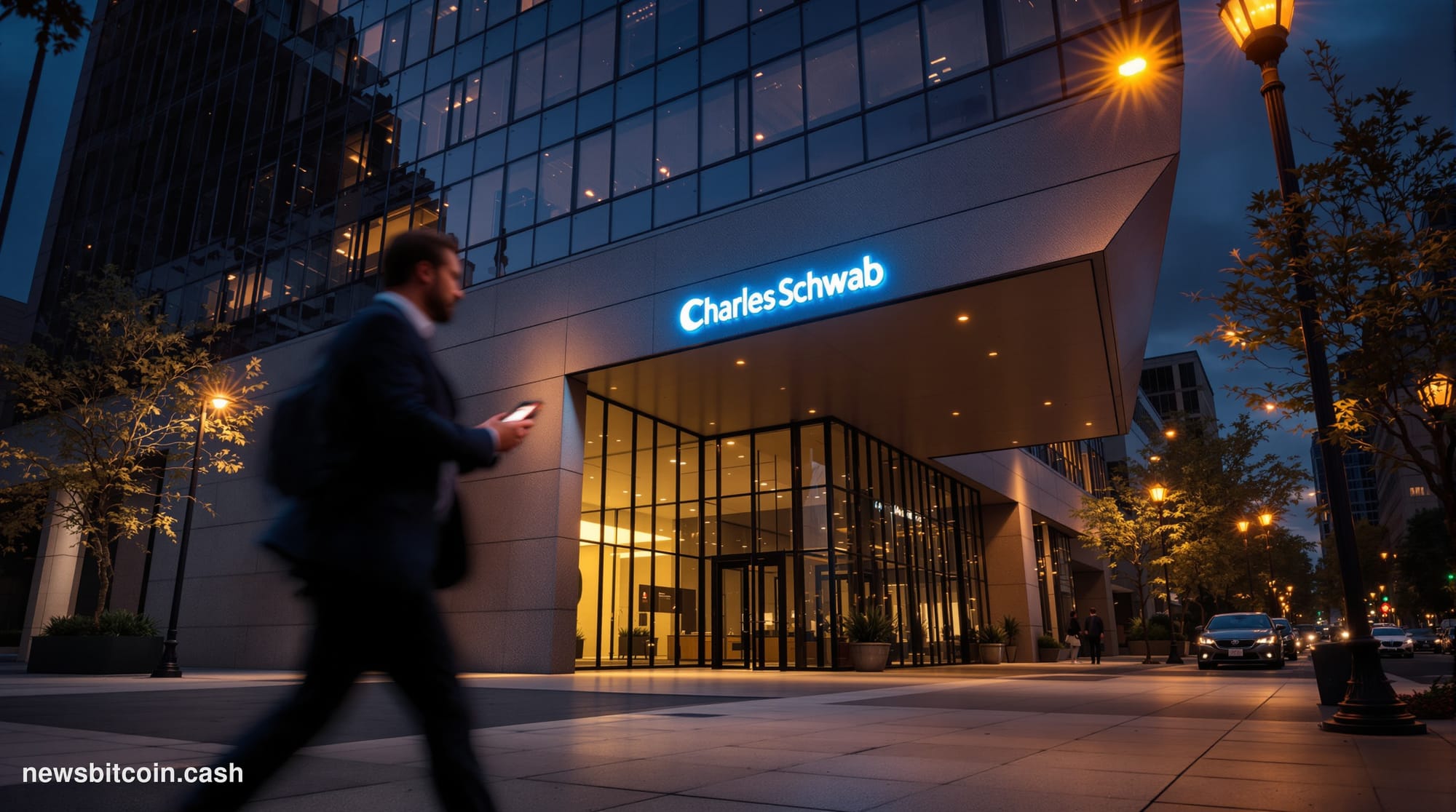
New research from Charles Schwab has landed with a clear message for anyone still debating whether retail crypto appetite in the United States is fading: it isn't. According to the brokerage giant's findings, American investors who already hold digital assets are planning to grow those positions over the coming year — a signal that the accumulation mindset, not exhaustion or retreat, defines the current mood among crypto-engaged households in the world's largest economy.
That finding may sound simple on its surface, but its source gives it considerable weight. Charles Schwab is not a crypto-native firm or a blockchain advocacy group with an incentive to paint the rosiest possible picture. It is one of the most established and conservative custodians in traditional finance, managing trillions of dollars in client assets and serving millions of American households across brokerage, retirement, and wealth management products. When Schwab's research desk surveys its investor base and finds forward-looking crypto accumulation intent, the financial establishment is effectively listening to its own customers tell it that digital assets belong in the portfolio mix — not as a curiosity, but as a line item they intend to grow.
This matters enormously for infrastructure providers, exchanges, and asset managers who have spent the past several years building institutional-grade products for precisely this moment. The question was always whether the retail base would sustain its interest once the speculative frenzy of any given cycle cooled. Schwab's research, published in October 2026, suggests the answer among existing holders is yes — and that the intent to add is forward-looking, not retrospective enthusiasm colored by recent price gains.
The distinction between existing holders wanting more versus new entrants discovering crypto for the first time is an important one. Existing holders represent a more informed, more committed segment of the investing public. They have already navigated the onboarding friction — the wallet creation, the exchange verification, the tax complexity — and they have stayed. Their stated intention to accumulate further over the next year reflects conviction rather than curiosity. It is the kind of durable demand signal that long-term infrastructure builders, from custodians to regulated exchanges to spot Securities and Exchange Commission-approved exchange-traded fund providers, depend on when making capital allocation decisions about product development and market expansion.
Schwab itself has been steadily moving toward crypto product offerings, a trajectory consistent with what its own research now confirms about client demand. The firm has discussed plans to offer spot Bitcoin trading directly to clients, a move that would eliminate the friction of clients going off-platform to access digital assets. If existing holders plan to add to positions, and Schwab can capture that activity within its own ecosystem rather than lose it to specialized crypto exchanges, the business case for the firm's crypto expansion becomes self-evident. Research that validates client demand also validates internal investment.
More broadly, the Schwab finding arrives at a moment when the institutional and retail crypto markets are increasingly difficult to separate. Spot Bitcoin and Ethereum exchange-traded funds have given traditional brokerage account holders a regulated, familiar vehicle to gain crypto exposure. The growth of those products over the past two years has blurred the line between someone who "owns crypto" and someone who holds a conventional ETF with digital asset exposure. Schwab's research likely captures both cohorts, which means the accumulation intent it identifies spans a spectrum from self-custodied Bitcoin holders to ETF investors who may not think of themselves as crypto-native at all. That breadth makes the finding more significant, not less — it reflects mainstream investor behavior, not the preferences of a niche community.
For the broader digital asset industry, the takeaway is structural. Markets are not purely driven by price momentum or macro liquidity conditions. They are also shaped by the stated intentions of the investors who hold the assets. When a Schwab survey reveals that the existing US crypto holder base plans to add over the next year, it creates a demand floor that functions independently of short-term price volatility. Accumulation intent among informed holders is exactly the kind of fundamental that underpins sustainable market development, as opposed to the speculative spikes that have historically defined crypto's boom-and-bust reputation.
The research, authored by Mathew Di Salvo and surfaced through Bitcoin Magazine, is sparse on granular methodology detail in the version available for review — but the headline finding is unambiguous. US investors with crypto exposure want more of it. For an industry that has spent years fighting for legitimacy with precisely the type of mainstream financial institution that Schwab represents, having that institution's own research confirm durable client demand is a form of validation that no amount of industry advocacy could manufacture.
Written by the editorial team — independent journalism powered by Bitcoin News.