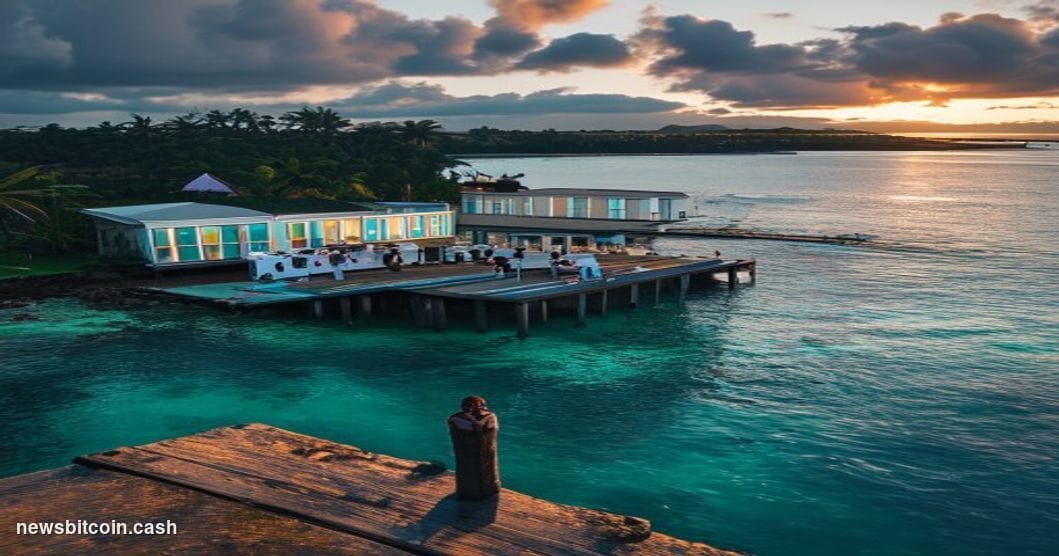
When industry observers map the world's most influential crypto jurisdictions, the usual suspects dominate the conversation: Dubai's virtual asset framework, Switzerland's Crypto Valley in Zug, Singapore's Monetary Authority licensing regime, and the United States with its sprawling and contentious regulatory architecture. Almost no one mentions the British Virgin Islands. That oversight is becoming harder to justify. Kraken, Bitstamp, 1inch, and Bitfinex have all established legal entities in this small British Overseas Territory — and the roster tells you everything about why the BVI deserves far more analytical attention than it currently receives.
There is one immediately striking detail about the BVI's crypto presence: if you tried to schedule an in-person meeting with a senior executive at one of these firms by flying into Tortola, you would almost certainly be disappointed. The registered entities exist on paper, managed through the archipelago's well-developed network of corporate agents and legal firms, but the operational heartbeats of these businesses — the engineers, traders, compliance officers, and decision-makers — are elsewhere. This is not unusual in global finance. The BVI has served as the offshore incorporation capital of the world for decades, hosting hundreds of thousands of International Business Companies for multinationals that have never placed a single employee on the islands. What is unusual is how cleanly the crypto industry has adopted this same model, and at what scale.
A Jurisdiction Built for Corporate Architecture
The BVI's appeal is structural, not accidental. The territory operates under English common law, which provides legal predictability and enforceability that matters enormously to institutional counterparties and investors. Its International Business Company framework, refined over decades of offshore financial service provision, allows for rapid incorporation, minimal local tax obligations, and flexible ownership structures. For crypto projects navigating a global regulatory patchwork — where a company's domicile can determine which users it can serve, which banking relationships it can maintain, and how its token issuance is legally classified — the BVI offers a degree of jurisdictional agility that few territories can match.
This agility is not the same thing as a regulatory vacuum. The BVI Financial Services Commission has developed frameworks touching on virtual assets, and the territory is acutely aware that its reputation as a credible offshore center depends on maintaining minimum standards that satisfy international anti-money laundering and financial compliance norms. The Financial Action Task Force's global standards apply through the territory's relationship with the United Kingdom, and BVI-incorporated entities frequently must satisfy compliance requirements in the jurisdictions where they actually operate. The BVI wrapper is a legal tool, not a regulatory escape hatch — a distinction that sophisticated operators understand well.
Who Is Actually There, and Why It Matters
The names on the BVI roster are not fringe actors. Kraken is one of the oldest and most institutionally embedded cryptocurrency exchanges in the world. Bitstamp, founded in 2011, is among the longest-operating exchanges in Europe and holds regulatory licenses across multiple jurisdictions including the European Union under the Markets in Crypto-Assets regulation framework. 1inch is one of the most widely used decentralized exchange aggregators in the decentralized finance ecosystem. Bitfinex, operated by iFinex, is one of the largest exchanges by volume and is closely linked to Tether, the issuer of the world's most widely used stablecoin by trading volume.
That these entities share a legal address in the BVI is not coincidental. It reflects a deliberate strategy of separating corporate domicile from operational geography — a practice that allows these businesses to optimize for legal flexibility at the entity level while maintaining operational presences in cities like London, Amsterdam, New York, and Seychelles. For projects that launched during crypto's early years, when regulatory clarity was essentially nonexistent and jurisdictional flexibility was an existential necessity, the BVI was one of a handful of territories that offered a workable legal foundation without immediately triggering enforcement attention.
The Quiet Infrastructure Beneath Crypto's Public Face
There is a broader point here about how the crypto industry's corporate architecture actually functions, versus how it appears in press releases and regulatory filings. The exchanges and protocols that most users interact with daily are frequently the retail-facing layer of multi-entity corporate structures spanning several jurisdictions simultaneously. A user on a European trading platform may be contracting with an EU-licensed entity that is itself a subsidiary of a BVI holding company, which in turn has operational relationships with technology providers incorporated elsewhere. This layering is not inherently suspicious — it mirrors the structure of any sophisticated multinational financial services firm — but it does mean that the BVI's influence on the crypto ecosystem is systematically larger than its name recognition suggests.
As regulatory frameworks mature globally — from the EU's Markets in Crypto-Assets regulation to Hong Kong's virtual asset service provider licensing and the United States' ongoing legislative efforts — the question of where crypto companies are legally domiciled will carry increasing weight. The BVI's position as a quietly dominant incorporation hub puts it at the center of that conversation, whether or not its name appears in the headlines. The executives may not be reachable on-island, but the legal architecture they have built there is very much shaping the industry from a distance.
Written by the editorial team — independent journalism powered by Bitcoin News.