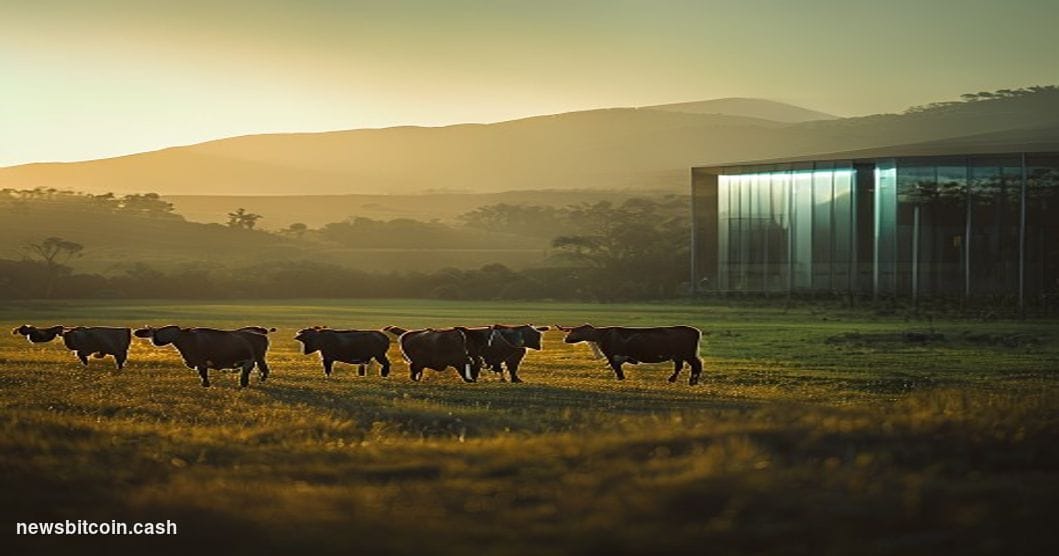
A small dairy farm in Brazil has quietly made financial history. Ten dairy cows — living, breathing agricultural assets — were tokenized and used as collateral to secure a loan of $19,600, with the transaction formally registered on B3, Brazil's main stock exchange. The deal is being reported as one of the country's first instances of tokenized livestock serving as loan collateral, and it signals something far larger than a single farmyard financing arrangement: the real-world asset tokenization wave is moving into territory most financial engineers never anticipated.
The mechanics are straightforward enough in principle. Each cow is assigned a unique digital token on a blockchain ledger, creating a verifiable, tamper-resistant record of ownership and value. That token can then be pledged against a loan just as a property deed or stock certificate might be — except the collateral moos, eats grass, and produces milk. The moment ten of those tokens backed a $19,600 credit facility and the transaction landed on B3's infrastructure, the concept stopped being theoretical. Brazil had just tokenized its pasture.
Why Livestock, Why Now
Brazil's agricultural sector is among the largest on the planet. The country holds one of the world's biggest commercial cattle herds, and livestock represents a substantial share of rural credit demand. Historically, farmers seeking working capital have faced considerable friction — collateral verification is slow, paperwork is burdensome, and lenders struggle to assess and monitor the value of biological assets that move, breed, and depreciate in non-linear ways. Tokenization attacks each of those pain points directly.
By anchoring a cow's identity and value to a blockchain token, lenders gain real-time visibility into the collateral pool. Smart contracts can, in principle, trigger alerts if herd numbers drop below a threshold, automate interest calculations tied to livestock valuations, or even facilitate liquidation through peer-to-peer token transfers without the logistical nightmare of physically repossessing animals. For rural credit markets across the developing world, that is a meaningful infrastructure upgrade.
The choice to register the transaction on B3 is also significant. B3 is not a scrappy startup blockchain platform — it is Brazil's primary exchange, operating equities, fixed income, derivatives, and currency markets for one of the ten largest economies in the world. Its involvement lends institutional legitimacy to what might otherwise be dismissed as an agricultural novelty, and it positions the exchange as a clearinghouse for real-world asset tokenization at a national scale. Brazil's financial regulators and market participants are watching an established, systemically important institution absorb a new asset class in real time.
The Broader RWA Push
The tokenization of real-world assets — spanning real estate, treasury bonds, trade receivables, commodities, and now livestock — has become one of the most actively developed segments of the blockchain industry. Major financial institutions globally have run pilots tokenizing money market funds, government debt, and trade finance instruments. But those experiments have largely centered on assets with liquid, well-understood pricing mechanisms and established legal ownership frameworks. Cows are different.
Biological assets present a distinct set of challenges: they have finite productive lifespans, they are subject to disease, drought, and mortality risk, and their valuation requires domain expertise that most credit analysts do not possess. Solving those problems at token-protocol level — through oracle integrations with livestock registries, insurance wrappers, and on-chain mortality reporting — would create a replicable template applicable to poultry, aquaculture, timber, and a range of other biological commodities that collectively represent trillions of dollars in global agricultural value. The $19,600 loan is, in that context, less important as a transaction and more important as a proof of concept stress-tested against a genuinely hard asset class.
Regulatory and Scalability Questions
Brazil has shown unusual openness to blockchain-based financial infrastructure. The country's central bank has been developing its own digital currency framework, and domestic regulators have engaged constructively with tokenization pilots across multiple asset classes. Registering this particular transaction on B3 suggests that at least some degree of regulatory comfort exists around the livestock collateral model, though the full legal framework — including how courts would handle enforcement in the event of default — remains to be tested at scale.
Scaling from ten cows and a $19,600 facility to a meaningful slice of Brazil's rural credit market will require standardization of livestock valuation methodologies, integration with Brazil's existing animal health and traceability systems, and likely some form of insurance or guarantee mechanism to satisfy institutional lenders. None of those are trivial undertakings. But the fact that B3, with its settlement infrastructure and regulatory relationships, is already in the picture suggests the scaffolding for that expansion is being assembled in earnest.
What This Means
A ten-cow, sub-$20,000 loan will not move markets this week. But the transaction on B3 represents something the tokenization industry has needed: proof that real-world asset infrastructure can operate on unglamorous, genuinely difficult collateral — not just pristine government bonds or blue-chip real estate. If Brazil can make tokenized livestock work within a regulated exchange environment, the template travels easily to other agricultural economies across Latin America, Africa, and Southeast Asia where livestock wealth is enormous and formal credit access remains severely constrained. The cows are doing more financial work than their market value suggests.
Written by the editorial team — independent journalism powered by Bitcoin News.