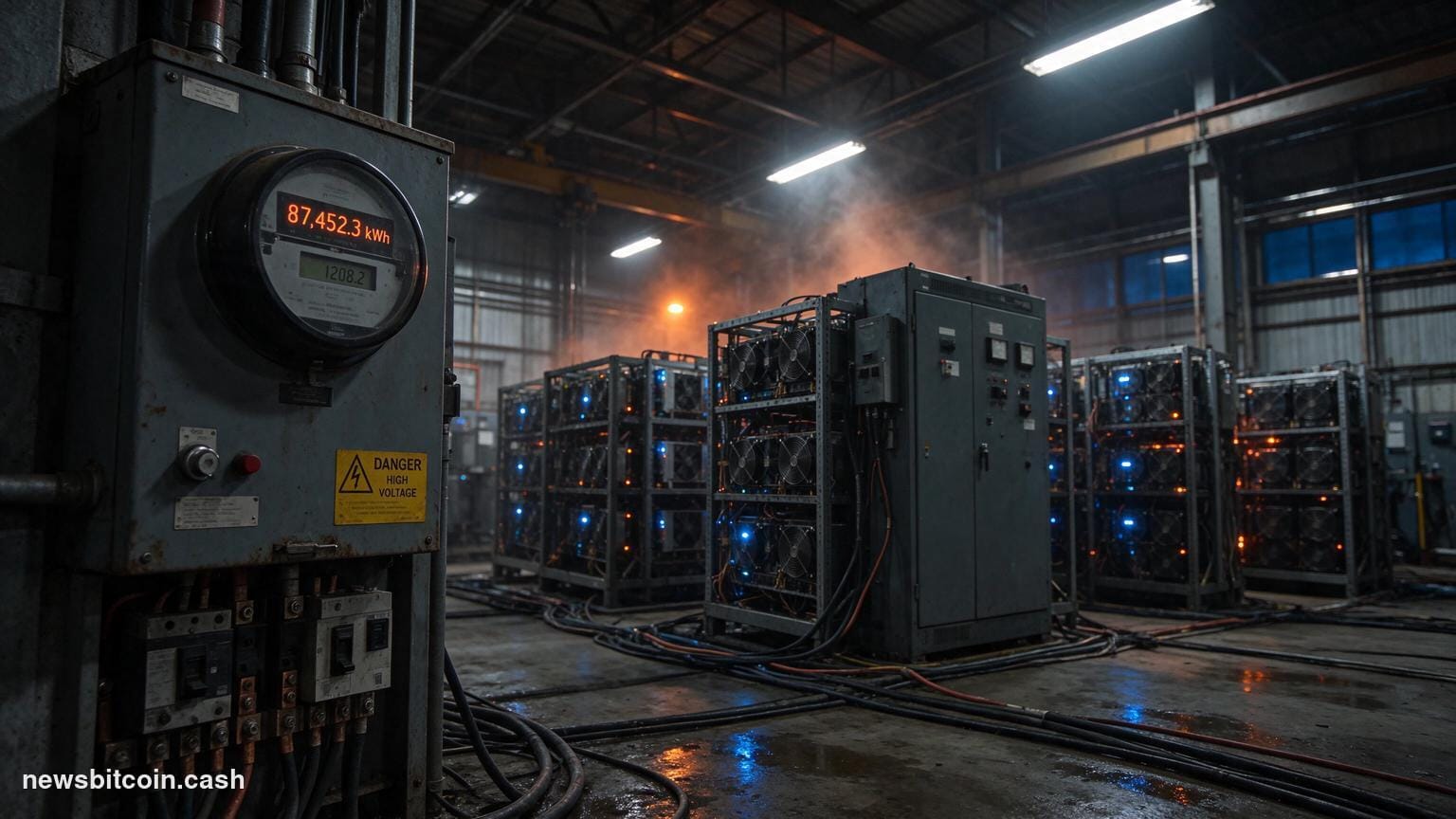
For the second time in Bitcoin's history, the cost of powering the machines that secure its network has climbed above the market price of the asset those machines produce. It is the kind of structural inversion that cuts to the heart of mining economics — and it is forcing the industry to ask a question it has long deferred: what happens when the fundamental arithmetic of proof-of-work stops working?
The answer, increasingly, is that miners are not waiting around to find out. Faced with electricity costs that now exceed what a freshly mined bitcoin is worth on the open market, major operators are pivoting toward Artificial Intelligence (AI) and High-Performance Computing (HPC) services as alternative revenue streams. The pivot is no longer a speculative hedge — it has become a survival strategy.
A Familiar Crisis With Deeper Roots
The first time electricity costs breached bitcoin's market price, it was treated as an anomaly — a temporary misalignment that the next price rally or difficulty adjustment would correct. The second crossing is harder to dismiss. It signals something more structural: a convergence of persistently elevated energy prices and a Bitcoin price that has not kept pace with the operational overhead of large-scale mining infrastructure.
Mining has never been cheap, but for most of its history the economics rewarded scale. Industrial operators who could negotiate grid-level power contracts, deploy the latest generation of application-specific integrated circuit (ASIC) hardware, and run lean on overhead could generate meaningful margins even through prolonged bear markets. That calculus depended, critically, on electricity remaining the variable cost — something that could be managed, hedged, or relocated. When electricity becomes the ceiling rather than the floor, the entire model requires rethinking.
The post-halving environment makes this dynamic more acute. Each halving event cuts block rewards in half, compressing miner revenue at the protocol level. When that compression coincides with rising industrial power costs — driven by grid congestion, regulatory changes in energy markets, or simple inflationary pressure on utilities — the squeeze becomes existential for operators without diversified income.
The AI and HPC Escape Valve
The migration toward AI and HPC workloads is not incidental. It is the logical response of operators who have already built the core infrastructure that both industries require: large physical footprints, robust power delivery systems, high-density cooling, and sophisticated network connectivity. The capital expenditure is sunk. What changes is the workload running on top of it.
AI training and inference, as well as broader HPC tasks like scientific simulation and financial modeling, demand exactly the kind of dense, reliable compute infrastructure that Bitcoin miners have spent years constructing. Graphics Processing Unit (GPU) clusters for AI workloads can be installed in facilities originally designed for ASIC racks, often without wholesale rebuilding. For miners sitting on expensive, long-term power contracts that suddenly look uneconomic for Bitcoin work, redirecting that capacity toward AI service contracts — which carry premium pricing — offers an immediate path to margin recovery.
Several publicly listed mining companies have already announced HPC and AI hosting divisions, signing multi-year contracts with cloud providers and enterprise AI customers hungry for guaranteed compute capacity. The trend has been building for over a year, but the second electricity-cost breach gives it renewed urgency across the broader operator base, not just the largest players with the resources to experiment.
What This Means for the Network
The implications extend beyond individual company balance sheets. If a meaningful portion of industrial mining capacity migrates toward AI and HPC — even partially, running Bitcoin mining only when margins turn positive — the network's hash rate dynamics become more volatile and harder to predict. Smaller, less-diversified miners who cannot pivot will face the starkest choice: absorb losses in hopes of a price recovery, or shut down rigs entirely.
Hash rate contractions, when they occur, trigger the network's difficulty adjustment mechanism, which periodically recalibrates how hard it is to mine a block. That self-correcting feature is one of Bitcoin's most elegant design properties. But it cannot fix an underlying energy cost structure that has fundamentally shifted. Difficulty can come down — that simply means fewer machines are competing, not that the remaining ones are suddenly profitable.
The second breach of this threshold is a signal the industry cannot absorb with optimism alone. It demands operational reinvention, and the miners moving fastest toward AI and HPC are the ones most likely to emerge from this period as durable infrastructure businesses rather than single-commodity operations perpetually at the mercy of a volatile asset price and an unforgiving power bill.
Written by the editorial team — independent journalism powered by Bitcoin News.