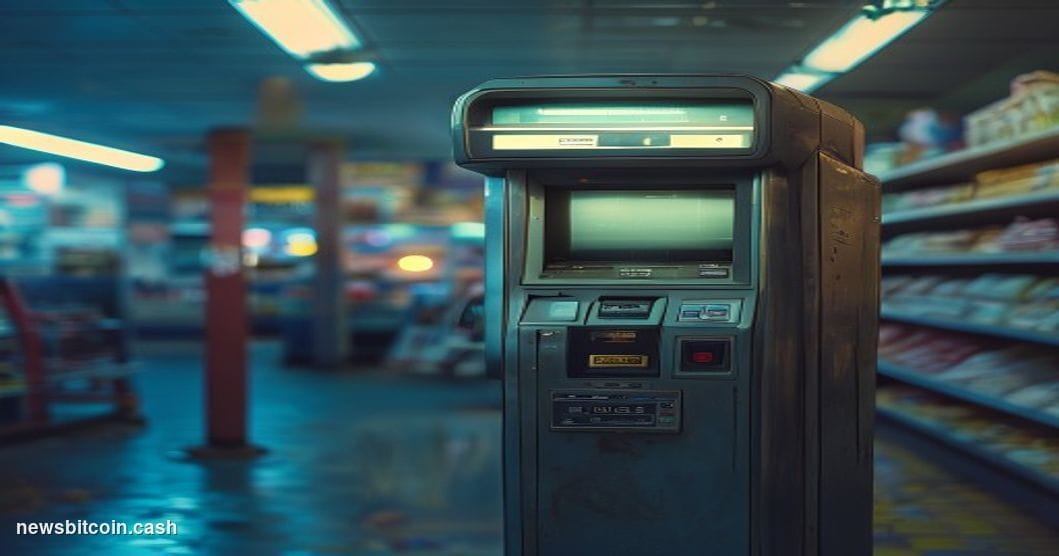
The crypto ATM revolution that once promised to democratize digital asset access across America has reached its inglorious conclusion. Bitcoin Depot, the company that built the nation's largest Bitcoin ATM network, filed for Chapter 11 bankruptcy protection on Monday and immediately shuttered its entire kiosk operation.
The filing, submitted to the US Bankruptcy Court for the Southern District of Texas, marks a spectacular fall for a company that positioned itself as the bridge between traditional retail and the digital asset economy. Bitcoin Depot's network of thousands of bright orange kiosks had become a familiar sight in gas stations, convenience stores, and shopping centers across the country, offering consumers the ability to purchase Bitcoin with cash in locations far removed from sophisticated trading platforms.
The bankruptcy represents more than just another crypto casualty—it signals the structural failure of a business model that never solved its fundamental economics. Bitcoin ATM operators have long struggled with a toxic combination of high operational costs, regulatory uncertainty, and consumer adoption patterns that never materialized at scale. The machines required constant maintenance, faced frequent technical issues, and imposed transaction fees that often exceeded 15% to 20%, making them prohibitively expensive for all but the most desperate users.
Regulatory Pressure Crushes Business Model
Bitcoin Depot's collapse comes amid intensifying regulatory scrutiny of the crypto ATM sector. Federal and state authorities have increasingly targeted these operations for compliance failures, particularly around anti-money laundering requirements and customer identification protocols. The machines became magnets for illicit activity, from romance scams targeting elderly victims to more sophisticated money laundering schemes that exploited the relative anonymity these kiosks provided.
The company's international footprint is also unwinding in coordinated fashion. While Bitcoin Depot's Canadian entities will join the US bankruptcy proceedings, other foreign units are winding down under applicable local laws. This synchronized global retreat underscores how regulatory pressure has made the crypto ATM business model untenable across multiple jurisdictions simultaneously.
The End of Physical Crypto Infrastructure
Bitcoin Depot's bankruptcy filing illuminates a broader truth about crypto infrastructure: the physical layer never delivered on its promise. Unlike traditional ATMs, which serve a genuine consumer need for cash access, Bitcoin ATMs solved a problem that largely didn't exist. As mainstream financial institutions began offering crypto services and mobile apps simplified digital asset purchases, the value proposition of driving to a gas station to buy Bitcoin at usurious fees evaporated.
The timing of Bitcoin Depot's collapse is particularly telling. After years of crypto market volatility and regulatory uncertainty, traditional financial institutions have finally embraced digital assets through proper channels. Coinbase has normalized crypto trading for retail investors, while institutional custody solutions have emerged for larger players. The crypto ATM, once positioned as a necessary on-ramp, became an expensive anachronism.
The company's decision to pull its entire kiosk network offline immediately upon filing suggests the operation had become completely unsustainable. Unlike typical Chapter 11 proceedings where companies attempt to reorganize and continue operations, Bitcoin Depot appears to have concluded that no viable path forward exists for its core business model.
What This Means for Crypto Access
Bitcoin Depot's bankruptcy removes a significant piece of crypto infrastructure from the American landscape, but the impact on actual crypto adoption will likely be minimal. The high-fee, low-convenience model these kiosks represented was already being displaced by superior alternatives. Retail investors seeking crypto exposure have migrated to established exchanges and financial apps, while institutional adoption has followed entirely different pathways.
The collapse does, however, mark the end of crypto's most visible attempt to replicate traditional banking infrastructure. The vision of Bitcoin ATMs as the digital equivalent of bank branches has proven fundamentally flawed. Digital assets, by their nature, don't require physical infrastructure in the way traditional banking does. The future of crypto access lies in seamless digital integration, not expensive standalone kiosks that charge premium fees for basic transactions.
For the thousands of retail partners who hosted Bitcoin Depot kiosks, the shutdown represents both lost revenue and a reminder of crypto's volatility. Many convenience store and gas station operators who welcomed these machines as supplementary income sources now face the prospect of removing defunct hardware and finding alternative uses for their floor space.
The Bitcoin Depot bankruptcy filing should serve as a cautionary tale about building crypto infrastructure around outdated models. The sector's future belongs to companies that understand digital assets as fundamentally different from traditional financial products, requiring new approaches rather than digitized versions of legacy systems. The era of the crypto ATM is over—and the industry is better for it.
Written by the editorial team — independent journalism powered by Bitcoin News.