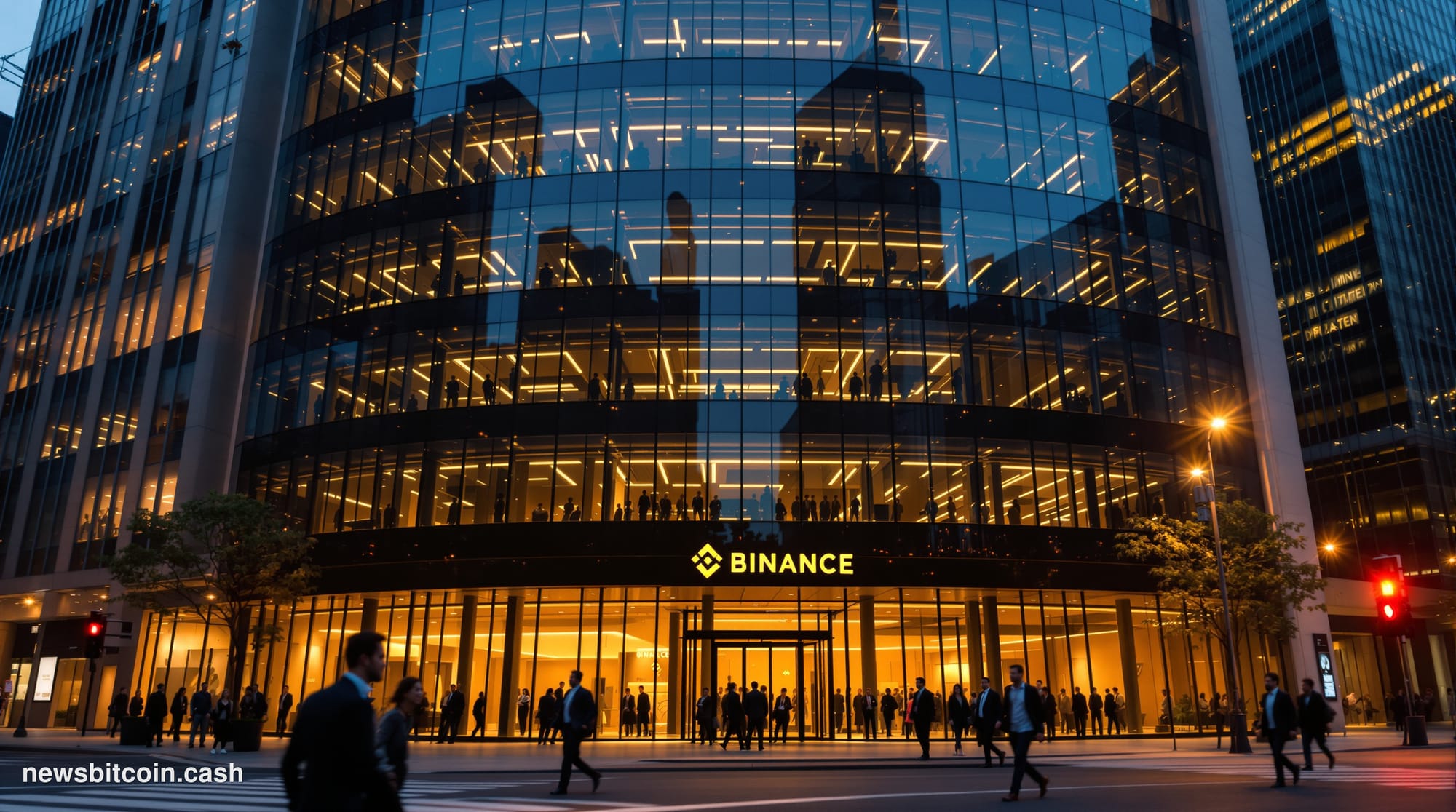
Binance, the world's largest crypto exchange by trading volume, is laying the groundwork for a tokenized initial public offering (IPO) program — one that would allow companies to issue equity on-chain rather than through conventional stock markets. The announcement, made by co-founder Yi He, comes alongside active recruitment for equity capital markets professionals, signaling that this is not a distant concept but an operational buildout already in motion. The caveat: none of it goes live until regulators sign off.
The specifics of the hiring campaign reveal the depth of Binance's ambitions here. The exchange is recruiting for equity capital markets roles, including an analyst position specifically tasked with developing tokenized equity products and evaluating prospective issuers. That language — "prospective issuers" — matters. It implies Binance intends to position itself not merely as a trading venue for tokenized shares, but as an underwriting and listing infrastructure provider. That is a fundamentally different business than operating a crypto spot or derivatives market, and it places Binance in direct structural competition with traditional capital markets gatekeepers: investment banks, stock exchanges, and securities brokers.
Yi He's framing of the initiative is deliberate. By anchoring the launch to regulatory approval rather than a speculative timeline, Binance is signaling institutional seriousness — an awareness that tokenized securities are not the same legal category as utility tokens or stablecoins, and that attempting to operate without explicit regulatory cover in this space would be commercially and legally self-defeating. This is a marked posture shift from the exchange's earlier years, when it frequently launched products first and navigated regulatory friction afterward. The compliance-first framing here is consistent with the broader rehabilitation effort Binance has been conducting since its landmark settlement with United States authorities.
The tokenized equity space has been heating up steadily. The core proposition is straightforward: represent traditional securities — shares in a private or public company — as blockchain-based tokens, enabling fractional ownership, 24/7 settlement, programmable distributions, and global accessibility without the friction of legacy clearing and custody infrastructure. For retail investors in markets with limited access to foreign equities, the appeal is obvious. For issuers, particularly growth-stage companies seeking to broaden their capital base, the ability to reach a global pool of crypto-native investors without a full traditional IPO process is genuinely attractive. The question has always been whether regulators would permit it at scale.
Several jurisdictions have been moving toward frameworks that could accommodate such products. Markets in the Middle East, Southeast Asia, and parts of Europe have shown varying degrees of receptivity to tokenized securities pilots. Binance's regulatory engagement across these regions, combined with its massive existing user base, would give any approved tokenized IPO program immediate distribution reach that no traditional exchange could match from a standing start. That distribution advantage is arguably the central strategic asset Binance brings to this market, more than any proprietary technology.
The analyst role Binance is filling — assessing prospective issuers — also suggests a vetting and due diligence layer that mirrors the function investment banks perform in traditional underwriting. If Binance builds out a full issuer-assessment pipeline, it is effectively constructing an on-chain capital markets desk. That infrastructure, once built, could support not just tokenized IPOs but secondary offerings, debt issuances, and other structured products. The equity capital markets hiring is therefore best read as the foundation layer for something considerably broader than a single product launch.
Skeptics will note that Binance has announced ambitious product categories before without full follow-through, and that regulatory approval in the tokenized securities space remains genuinely uncertain across most major markets. The United States, in particular, maintains a complex and still-evolving stance on whether tokenized equities constitute securities subject to full Securities and Exchange Commission (SEC) oversight, and what licensing obligations that would impose on a platform like Binance. Yi He's conditional framing — after regulatory approval — is prudent precisely because that approval is not guaranteed anywhere on a fixed timeline.
What this means for the broader industry is significant regardless of when or whether Binance's specific program launches. The world's dominant crypto exchange publicly committing resources to tokenized IPO infrastructure normalizes the concept at institutional scale. It pressures competitors — both traditional exchanges exploring tokenization and crypto-native platforms building similar rails — to accelerate their own frameworks. And it sends a signal to issuers, lawyers, and regulators that tokenized capital markets are a category that now demands serious structural attention, not just pilot experiments. When Binance hires analysts to assess your company as a prospective issuer, the category has arrived.
Written by the editorial team — independent journalism powered by Bitcoin News.