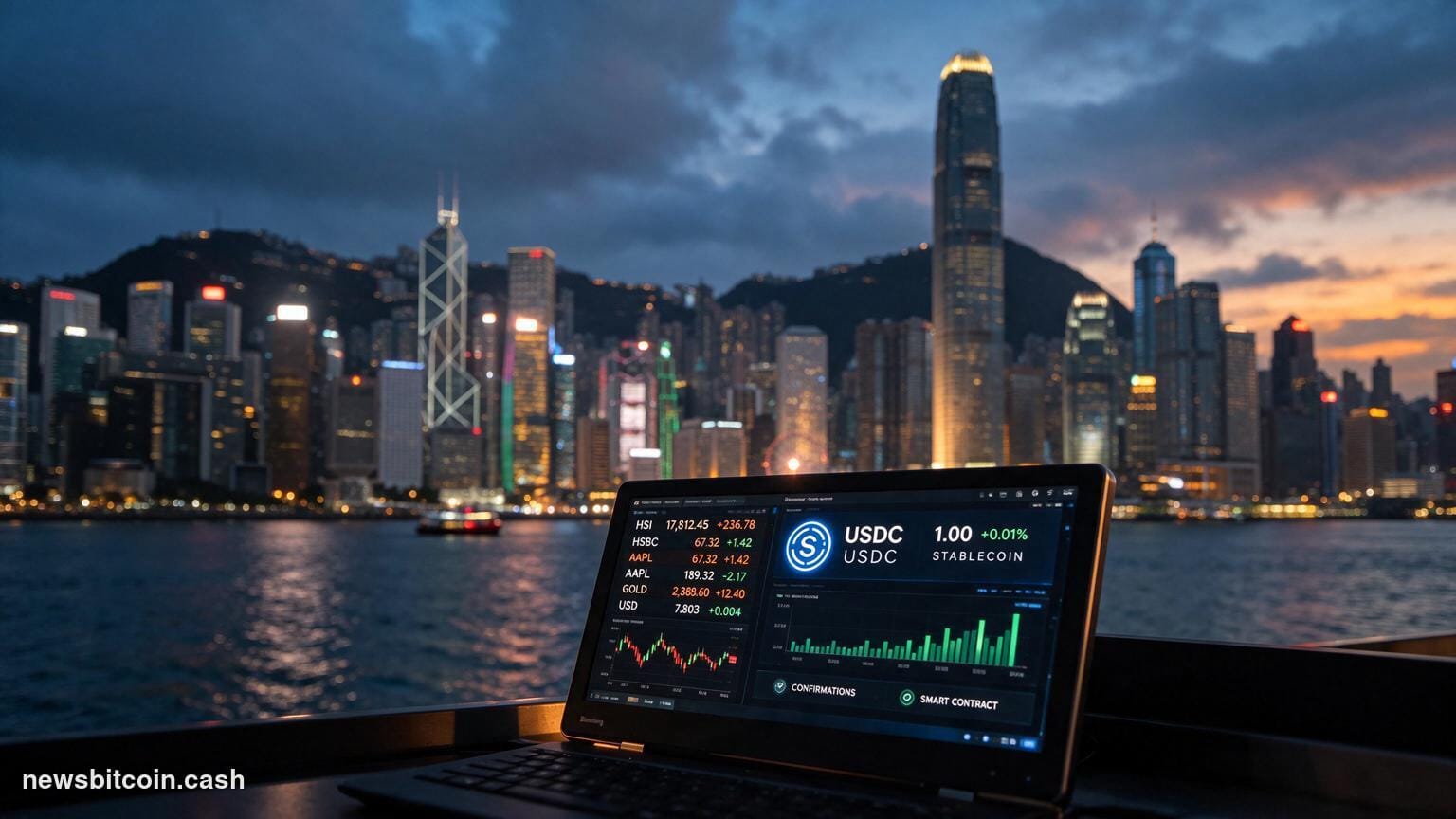
Binance, the world's largest crypto exchange by trading volume, is set to open access to Hong Kong-listed stocks and exchange-traded funds (ETFs) on December 1, 2026 — giving eligible users the ability to buy more than 1,000 traditional securities directly using USDC, the dollar-pegged stablecoin issued by Circle. The announcement, made just two days before the planned launch, marks one of the most direct collisions yet between centralized crypto infrastructure and conventional equity markets.
The mechanics are straightforward but the implications are not. Users who qualify under Binance's eligibility criteria — the exchange has not opened the product to the Hong Kong public — will be able to settle equity purchases in USDC rather than fiat currency routed through traditional banking rails. That means a stablecoin originally designed to facilitate crypto-to-crypto trading now becomes the settlement layer for buying shares in publicly listed companies. The product strips out a layer of financial intermediation that has persisted for decades, replacing it with on-chain dollar liquidity.
The carve-out from Hong Kong's general public is a significant detail worth examining. Hong Kong has been aggressively positioning itself as a regulated crypto hub, issuing exchange licenses and encouraging retail participation in digital assets. Yet Binance's stock-trading product is explicitly not open to Hong Kong residents at launch. This likely reflects the regulatory complexity of offering securities brokerage services in a jurisdiction with its own Securities and Futures Commission rules, and suggests Binance is walking a careful line — operating in Hong Kong's orbit while not directly engaging the local retail market it cannot yet fully serve.
Stablecoins as Brokerage Infrastructure
The choice of USDC as the settlement asset is deliberate and telling. USDC is a regulated stablecoin with transparent reserve reporting and institutional backing, making it a far more credible instrument for securities settlement than many alternatives in the crypto ecosystem. By routing equity purchases through USDC rather than through Binance's native BNB token or even Bitcoin, the exchange signals that it is building a product designed for institutional credibility rather than speculative appeal. USDC functions here less like a speculative asset and more like a digitized cash account — the crypto equivalent of a money market fund sitting at the edge of a brokerage.
This architecture also has practical advantages. USDC transactions can settle significantly faster than traditional fiat wire transfers, potentially compressing the settlement window for equity trades in a way that benefits active traders. If Binance can demonstrate that stablecoin-settled equity trades execute cleanly and without counterparty friction, it builds a replicable template for rolling this product out across other markets where it has regulatory footing.
TradFi-Crypto Convergence Accelerates
What Binance is attempting in Hong Kong is a live test of a thesis that has been circulating in crypto infrastructure circles for years: that the exchange layer of traditional finance is redundant if you already have a trusted digital settlement asset and a large enough user base. With more than 1,000 stocks and ETFs available from day one, the selection is not a proof-of-concept — it is a functional brokerage shelf broad enough to satisfy diversified portfolio construction.
The timing is also notable. The broader crypto industry has spent 2026 pushing deeper into traditional financial products — tokenized Treasuries, spot Bitcoin ETFs maturing in the United States, and stablecoin legislation advancing through multiple jurisdictions. Binance's Hong Kong stock move is the logical next step in that progression: not tokenizing traditional assets and bringing them on-chain, but using on-chain assets — specifically stablecoins — to purchase traditional assets directly. It inverts the usual direction of travel and positions crypto rails as the payment infrastructure rather than the investment destination.
Whether regulators in other markets will permit Binance to extend this model globally remains the central question. The exchange has faced sustained regulatory pressure across multiple jurisdictions in recent years, and its ability to deliver this product cleanly in Hong Kong will be watched closely by compliance teams and licensing authorities worldwide. A smooth December 1 launch would meaningfully strengthen Binance's case that it can operate regulated financial products at scale. A stumble would reinforce the doubts that have shadowed the exchange through years of enforcement actions and leadership changes.
For the digital assets industry, the stakes extend beyond any single exchange. If stablecoin-settled stock trading normalizes — even in a restricted, eligibility-gated form — it establishes a precedent that crypto infrastructure can support traditional securities markets without requiring a wholesale migration to blockchain-native instruments. That is a quieter but more durable form of adoption than any token price rally, and it deserves to be treated as such.
Written by the editorial team — independent journalism powered by Bitcoin News.