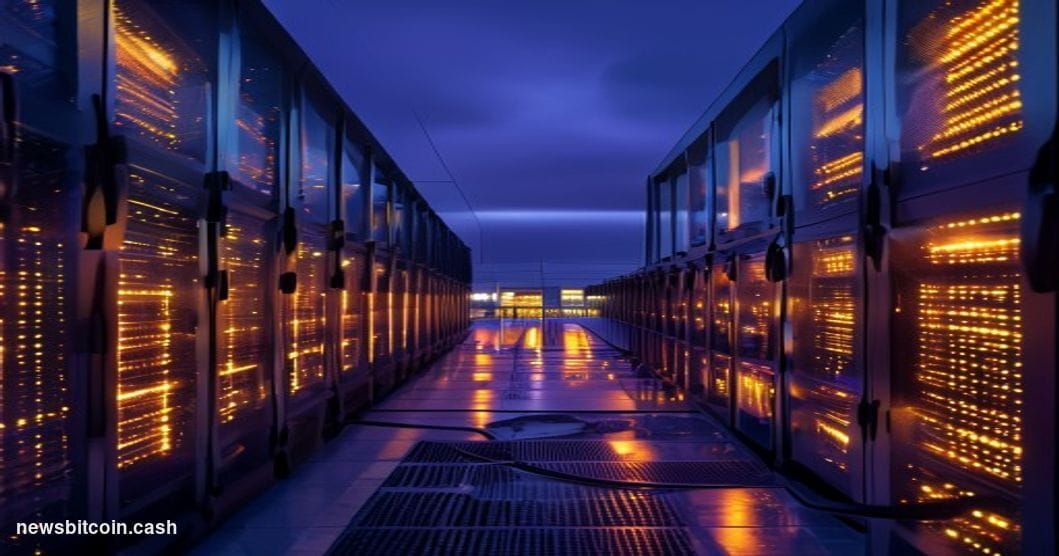
Wall Street research firm Bernstein has issued a bullish call on the Bitcoin mining sector, arguing that partnerships between artificial intelligence data centers and third-party mining operators are not merely convenient business arrangements — they are structurally necessary to resolve a deepening compute power crisis gripping the AI industry.
The argument cuts to the heart of one of the most underappreciated infrastructure stories in technology today. AI data centers are consuming electricity at a pace that existing grid connections and purpose-built facilities cannot satisfy quickly enough. New hyperscale builds take years to plan, permit, and energize. Bitcoin miners, by contrast, already operate some of the densest concentrations of energized, connected, and thermally managed compute infrastructure on the planet — facilities that can be partially repurposed, co-located with, or directly contracted to support AI workloads in ways that shave years off typical development timelines.
Bernstein's analysts see this dynamic not as a passing trend but as a durable structural shift. The power limits constraining AI expansion are not going away on a short horizon. Demand for graphics processing units and the electricity to run them is growing faster than utilities can build new substations and transmission lines. Against that backdrop, any entity sitting on reliable, high-capacity power interconnects — which is precisely what industrial-scale Bitcoin miners hold — becomes a strategic asset rather than a speculative mining play.
This reframing matters enormously for how investors should think about the mining sector. For years, publicly listed miners were evaluated almost exclusively on hash rate, energy cost per coin, and proximity to the next halving cycle. That framework is incomplete now. The more relevant question is how much contracted, energized capacity a miner controls and whether that capacity can serve dual-purpose or transitional roles as AI infrastructure demand accelerates. Bernstein's bullish posture reflects exactly this expanded lens.
The mechanics of these deals typically involve Bitcoin mining operators either leasing portions of their physical facilities and power contracts to AI or high-performance computing tenants, or pivoting entire sites toward GPU-based workloads while retaining some mining operations as a cash-flow hedge. Some of the largest publicly traded miners have already begun executing agreements along these lines, and Bernstein's analysis suggests this is not the ceiling but the early innings of a broader realignment. Third-party providers — miners who may not be household names — will play an increasingly critical role in filling gaps that hyperscalers like Microsoft, Amazon, and Google cannot close fast enough through organic construction alone.
There is also a geopolitical layer worth acknowledging. The race to dominate AI infrastructure is no longer purely a corporate competition — it carries national security dimensions that have drawn the attention of governments across North America, Europe, and Asia. Bitcoin mining facilities, many of which are located in energy-rich regions of the United States and Canada with existing grid access, are well-positioned geographically for this transition. Their operators understand power procurement, thermal management, and high-density hardware deployment at a level of sophistication that translates directly to AI data center operations, even if the specific silicon differs.
Critics will point out that the transition is not frictionless. Application-Specific Integrated Circuit (ASIC) miners and GPU clusters have different power density profiles, cooling requirements, and networking architectures. A Bitcoin mining shed is not a drop-in GPU farm. But Bernstein's thesis does not require a perfect conversion — it requires that mining operators' existing power rights, land, and infrastructure relationships provide a faster and cheaper on-ramp to energized AI capacity than building from scratch. On that narrower and more defensible claim, the evidence is compelling.
What this means for the sector is a fundamental repricing of how Bitcoin mining companies are valued. Investors who continue to model these businesses purely on Bitcoin price and network difficulty are missing a growing component of their worth: the strategic value of contracted power in an era of acute energy scarcity for compute. Bernstein's bullish stance suggests the Street is beginning to catch up to this reality. For miners who have spent years defending their social license and navigating volatile crypto cycles, the AI power crunch may prove to be the most consequential tailwind their industry has ever encountered — one built not on speculation but on the unglamorous, durable logic of electrons and infrastructure.
Written by the editorial team — independent journalism powered by Bitcoin News.