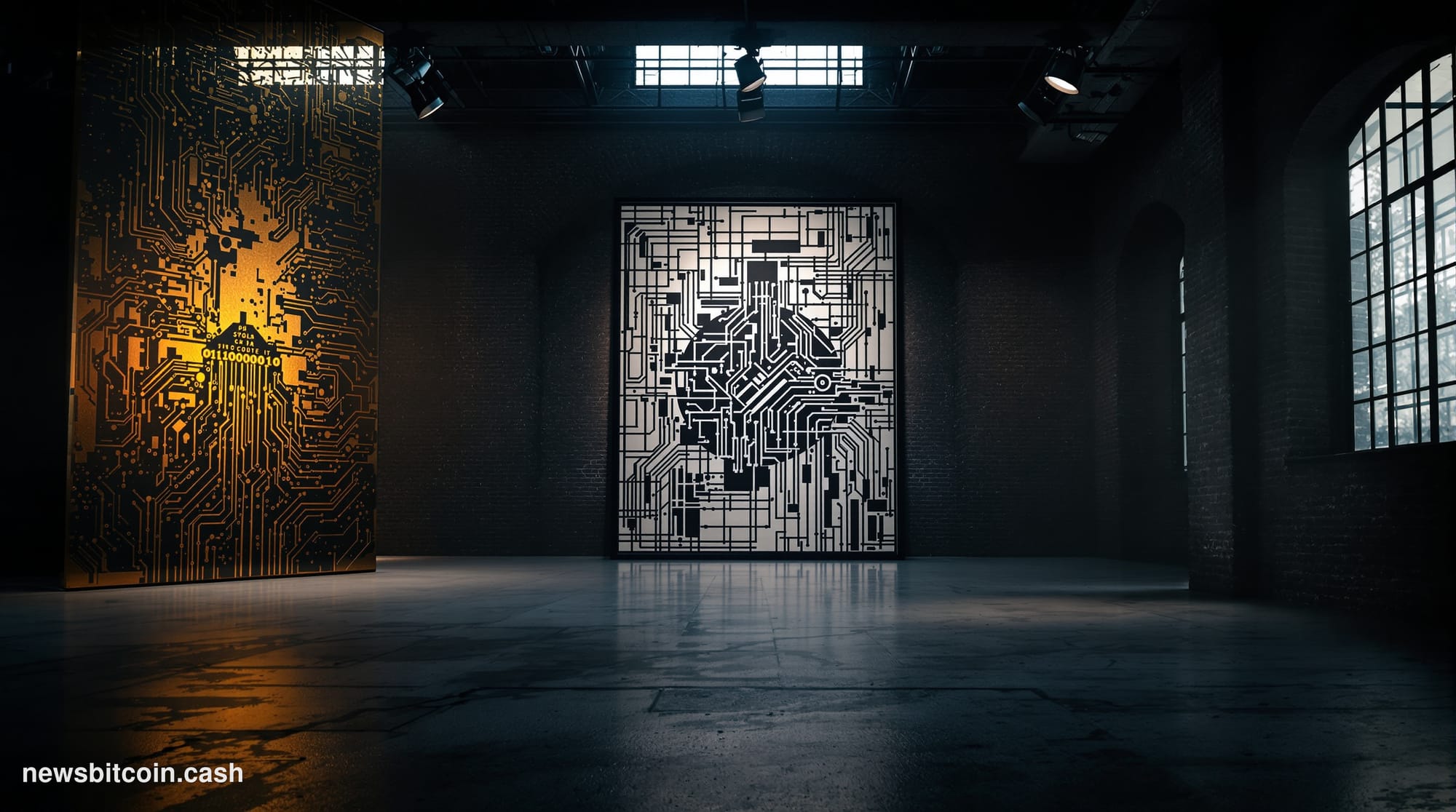
In the months leading up to Bitcoin Amsterdam, three European artists are doing something the financial industry has long struggled to accomplish: making money legible. Not in the regulatory sense, not in the compliance sense, but in the raw, perceptual sense — rendering visible the systems of value that govern everyday life yet remain almost entirely abstract to the people living inside them. ZETRA, RYR, and Cypherpunk Now are working at the intersection of monetary philosophy and visual culture, and their work arrives at a moment when the movement that inspired them is grappling seriously with its own transformation.
That transformation is the real subject underneath the art. Bitcoin, which began as a cypherpunk provocation — an attempt to route around the institutional architecture of money itself — has spent the better part of a decade acquiring the very institutional trappings it once set out to circumvent. Exchange-traded funds, corporate treasury allocations, central bank policy discussions that now routinely reference it by name. The movement, as writer Dennis Koch frames it in his Bitcoin Magazine feature, is openly confronting its own institutional success. The artists he profiles are not separate from that confrontation. They are, in many ways, its most honest expression.
Culture as Infrastructure
It is easy to treat art adjacent to a financial movement as decoration — as branding for a cause that lives primarily in whitepapers and block explorers. The work of ZETRA, RYR, and Cypherpunk Now resists that reduction. Each approaches the question of money not as a technical puzzle to be solved but as a cultural condition to be examined. What does it mean that the unit of account governing most human decisions is invisible, intangible, and almost entirely mediated by institutions that most people will never scrutinize? What happens when you try to make that system show itself?
These are not new questions. Conceptual artists have prodded the boundaries of economic representation for decades — from Hans Haacke's institutional critiques in the 1970s to the post-2008 wave of artists responding to financial collapse. What distinguishes this European cohort is their specific anchor: Bitcoin, not as investment thesis but as cultural object. They are less interested in price than in protocol, less interested in gains than in what the existence of a mathematically enforced monetary system reveals about the assumptions embedded in the one it challenges.
The Cypherpunk Thread
The name Cypherpunk Now is itself a statement of continuity — a deliberate link to the listserv culture of the 1980s and 1990s that produced the intellectual raw material from which Bitcoin was eventually assembled. Privacy as political practice, cryptography as civil liberty, code as speech. That tradition was always as much a cultural and philosophical project as a technical one, and the artists gathering around Bitcoin Amsterdam are recovering that dimension at precisely the moment when the broader ecosystem risks losing it to the gravity of institutional adoption.
ZETRA and RYR, for their part, each bring distinct aesthetic vocabularies to the shared project. Without reducing their work to allegory, both engage with the sensory and experiential dimensions of monetary systems — the textures of value, the weight of scarcity, the strange phenomenology of trusting a ledger you cannot hold. In an era when the most consequential financial instruments are layers of abstraction stacked on other abstractions, giving form to these systems is not merely artistic gesture. It is a kind of epistemological service.
Confronting Institutional Success
The tension Koch identifies — a movement confronting its own institutional success — deserves to be taken seriously rather than dismissed as nostalgia for a purer past. Institutions are not neutral containers. They reshape the content they hold. Bitcoin adopted by sovereign wealth funds and offered through regulated custodians is not identical, culturally or politically, to Bitcoin as a tool for individuals seeking exit from failing monetary systems. The protocol may be the same. The meaning is negotiated continuously, and that negotiation happens as much in culture as in markets.
Art does not resolve this tension, and the best of it does not try. What ZETRA, RYR, and Cypherpunk Now offer, gathering ahead of one of Europe's flagship Bitcoin events, is something more durable than resolution: a sustained attention to what money is, what it does, and what it conceals. At a moment when Bitcoin's financial story is louder than ever, that attention to the cultural undercurrent — the one flowing beneath price charts and ETF approval cycles — may be exactly what the movement needs most.
Why Amsterdam
The choice of Amsterdam as a gathering point for this conversation is not incidental. The city carries a long history as a node for both financial innovation and artistic radicalism — the Dutch Golden Age saw the emergence of some of the earliest sophisticated capital markets alongside an extraordinary flowering of visual culture. That history does not map cleanly onto the present, but it provides a resonant backdrop for artists asking what it means to make money visible in the twenty-first century. Bitcoin Amsterdam, as a venue, brings together the technical, the financial, and increasingly the cultural threads of a global movement, and the presence of artists like these three signals that the conversation is widening in productive directions.
The infrastructure of any monetary revolution is not only cryptographic. It is also symbolic, aesthetic, and narrative. If Bitcoin is to be more than a better settlement layer, it needs people willing to ask harder questions about value, representation, and power — and to render those questions in forms that move people who will never read a technical whitepaper. That is what these artists are building, one canvas, one installation, one provocation at a time.
Written by the editorial team — independent journalism powered by Bitcoin News.