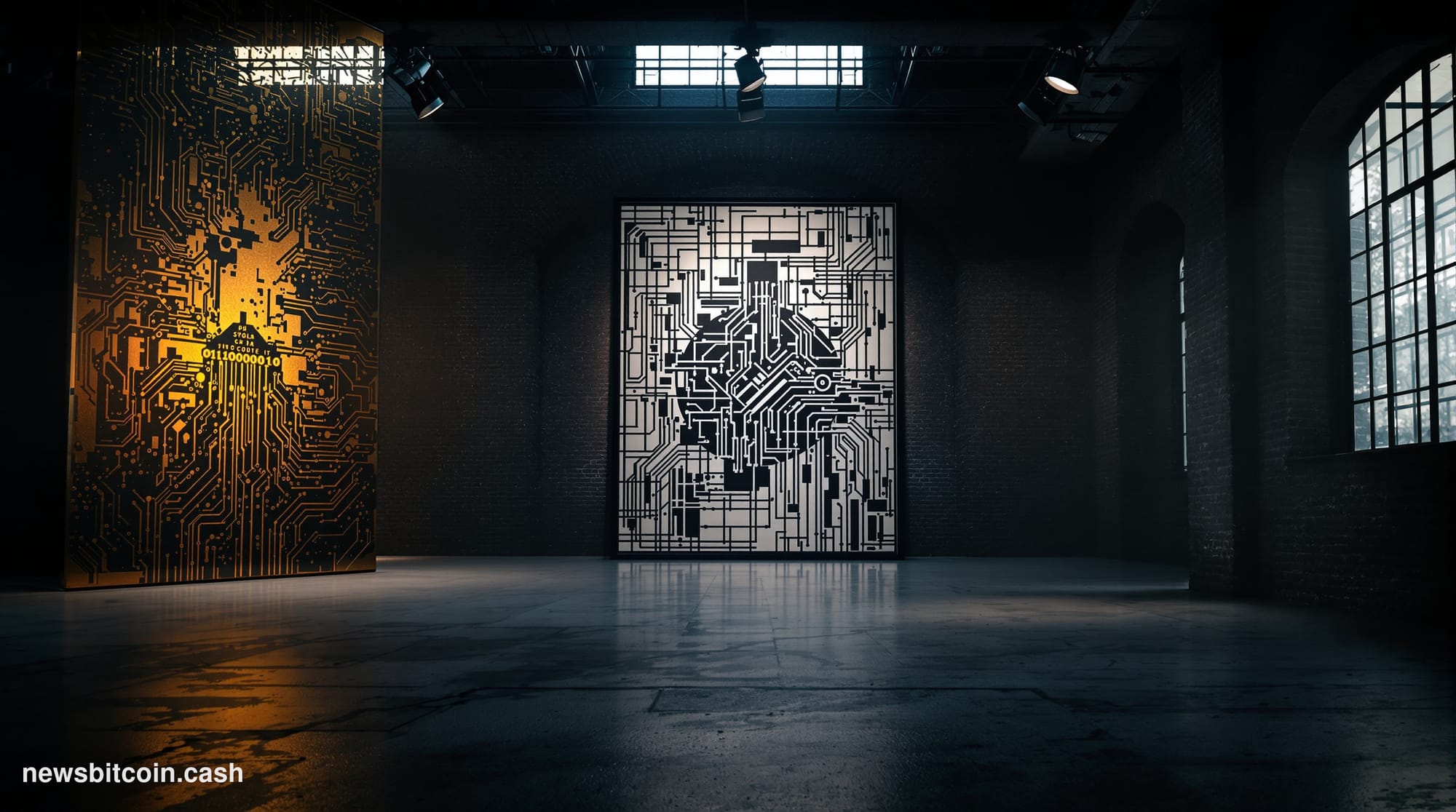
On October 29, in the heart of Buenos Aires, the Argentine Bitcoin community did something that few movements born from internet forums and cryptographic whitepapers have managed: they put their philosophy in steel and glass on a public plaza. Bitcoin.ar, the country's leading Bitcoin advocacy organization, unveiled a 2.4-meter stainless steel and glass cube titled "The Genesis of Satoshi Nakamoto" at Polo Dot, one of the city's prominent technology and innovation hubs, as part of the Open Fest program running alongside LABITCONF 2026.
The choice of medium — a large-format, permanent-grade sculpture in polished stainless steel and glass — is deliberate and telling. Bitcoin communities across the world have long debated how to translate a digital, decentralized protocol into something with physical gravity. Street art, murals, and pop-up installations have served that function in pockets of El Salvador, Miami, and Amsterdam. What Bitcoin.ar has done in Buenos Aires is a step beyond: a formal, architecturally scaled artwork planted at the intersection of a major technology district and one of Latin America's most prominent annual Bitcoin conferences.
The timing is not incidental. Argentina has spent years living through precisely the kind of monetary dysfunction that Satoshi Nakamoto's 2008 white paper was written to address — persistent inflation, currency controls, repeated sovereign debt crises, and a population with deep, generational distrust of its central bank. That context gives a monument to Bitcoin's pseudonymous creator a resonance in Buenos Aires that it might lack in Zurich or Singapore. The artwork is not purely aesthetic. It is argumentative. It is making a claim about where Argentina's economic future should be anchored.
LABITCONF — the Latin American Bitcoin and Blockchain Conference — has been a fixture of the regional crypto calendar for over a decade, rotating between cities and consistently drawing builders, entrepreneurs, and policymakers from across the hemisphere. Hosting its 2026 edition's Open Fest program in Buenos Aires, with Polo Dot as a backdrop, underscores how thoroughly Argentina has positioned itself as the region's most intellectually serious Bitcoin market. The country's Bitcoin adoption has not been driven primarily by speculation; it has been driven by necessity and by an unusually technically literate grassroots community.
The sculpture itself — a cube measuring 2.4 meters in stainless steel and glass — carries its own symbolic weight. The cube is a form without hierarchy, the same from every angle, a shape associated in architecture and art with universality and mathematical purity. Stainless steel speaks to permanence and resistance to corrosion — a pointed metaphor when placed in a country whose national currency has lost extraordinary purchasing power over successive decades. Glass implies transparency, the see-through auditability that Bitcoin's open ledger represents against the opacity of traditional monetary systems. Whether these readings were explicit in the artists' and organizers' intent or emergent from the material choices, they land with clarity in context.
The public installation model matters here too. By situating "The Genesis of Satoshi Nakamoto" at Polo Dot — a space accessible to city residents, conference attendees, and passersby alike — Bitcoin.ar has pulled Bitcoin discourse out of conference rooms and Twitter threads and placed it into shared civic space. That is a meaningful escalation. Monuments shape how communities understand their own history and values. Buenos Aires has long had a rich tradition of public art carrying political and economic weight; the placement of this work in that tradition is a statement that the Bitcoin community considers itself part of the city's broader cultural and civic life, not merely a subculture convening annually at a hotel ballroom.
What this moment signals, beyond the symbolism, is a maturing of Latin American Bitcoin culture into something with permanence ambitions. Early adopter communities build apps and meetups. More rooted communities build institutions, advocacy organizations, and, eventually, monuments. Bitcoin.ar's decision to commission and publicly debut a sculpture of this scale at LABITCONF 2026 suggests the Argentine Bitcoin community has crossed a threshold — from movement into institution, from idea into artifact. Whether the artwork becomes a lasting landmark of the Buenos Aires technology district or a footnote depends on what the broader ecosystem builds around it. But the cube is there now, in steel and glass, and that counts for something that code alone cannot.
Written by the editorial team — independent journalism powered by Bitcoin News.