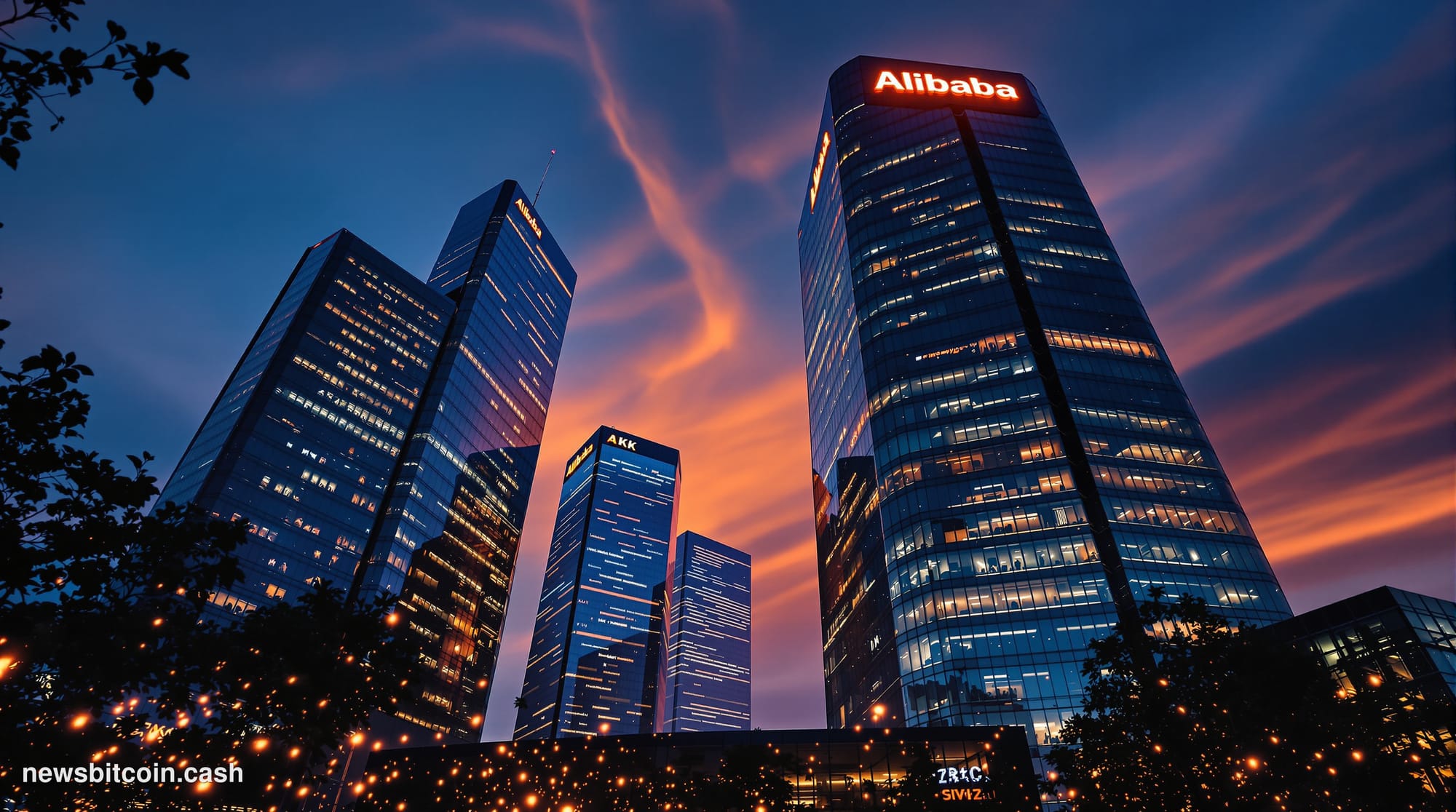
When a company the size of Alibaba moves $10 billion in a single share placement and points the entire sum at artificial intelligence, the market would be wise to pay attention. The Chinese e-commerce and cloud computing giant announced the capital raise on Sunday, framing it explicitly as a strategic acceleration into AI — a sector where the competitive stakes are rising faster than most incumbents can sprint. This is not a routine treasury maneuver. It is a declaration of intent from one of the world's most consequential technology conglomerates.
The mechanics of the placement matter as much as the headline figure. By issuing new shares rather than taking on debt, Alibaba is betting that equity investors will absorb the dilution in exchange for a credible AI growth narrative. That calculus reflects both the current appetite for AI-linked assets globally and Alibaba's own need to move decisively in a sector where compute infrastructure, foundational model development, and cloud AI services are consuming capital at an extraordinary pace. A $10 billion injection is substantial even by Silicon Valley standards, let alone within the context of a company navigating a complex regulatory and macroeconomic environment in China.
What exactly the funds will build remains the central question. AI investment at this scale typically divides across three broad buckets: proprietary large language model development, the data center and graphics processing unit infrastructure required to train and serve those models, and the application-layer integrations that convert raw capability into commercial products. Alibaba's existing cloud division, Alibaba Cloud, already positions the company as the dominant infrastructure provider for AI workloads across much of Asia. A $10 billion commitment could meaningfully accelerate its ability to compete head-to-head with Amazon Web Services, Microsoft Azure, and Google Cloud in the enterprise segment internationally.
The timing carries geopolitical weight. The global race for AI supremacy is no longer purely a commercial competition — it is entangled with chip export restrictions, national industrial policy, and questions about which jurisdictions will anchor the next generation of digital infrastructure. Alibaba's move to raise fresh equity now, while global investor appetite for AI narratives remains strong, suggests leadership is acutely aware of the window available to it. Waiting another 12 to 18 months could mean competing in a landscape where Western hyperscalers have further consolidated their model advantages and secured more of the high-end semiconductor supply chain.
For the crypto and digital assets industry, Alibaba's strategic pivot carries indirect but significant implications. AI and blockchain infrastructure are increasingly adjacent industries — sharing GPU compute markets, competing for data center capacity, and converging in applications like decentralized AI networks, verifiable computation, and on-chain AI agents. When a player of Alibaba's scale moves $10 billion into AI hardware and cloud development, it ripples through the same supply chains that Web3 infrastructure projects depend on. Compute costs, chip availability, and cloud pricing do not exist in isolation from one another.
There is also an investor dynamics angle worth examining carefully. Institutional capital has increasingly treated AI and digital assets as parallel bets on the next infrastructure paradigm. A highly visible $10 billion equity placement from Alibaba — if it prices well and trades strongly in the secondary market — could validate continued rotation into technology growth assets broadly, including crypto-adjacent equities and blockchain infrastructure tokens. Conversely, if the placement is perceived as dilutive or the AI strategy underdelivers, it could trigger a broader reassessment of technology growth premiums across asset classes.
Alibaba's announcement also arrives as the global conversation about AI governance and responsible deployment intensifies. Regulatory scrutiny over large-scale AI investment is not limited to China — European and American legislators are actively debating oversight frameworks for frontier AI systems. A company deploying $10 billion under the banner of an AI pivot will face questions about safety commitments, data practices, and the geopolitical provenance of its technology stack. How Alibaba navigates those pressures could set precedent for how other major non-Western AI investors present their strategies to global markets.
What this means, in practical terms, is straightforward: the race to own the AI infrastructure layer of the global economy just got materially more competitive. Alibaba's $10 billion share placement is not a hedge or a diversification move — it is a commitment to compete at the highest tier of the AI buildout. For investors, technologists, and anyone watching the intersection of capital markets and emerging technology, this signals that the consolidation phase of AI infrastructure investment is accelerating, and the companies not yet at the table at this scale may find the seat increasingly expensive to secure.
Written by the editorial team — independent journalism powered by Bitcoin News.