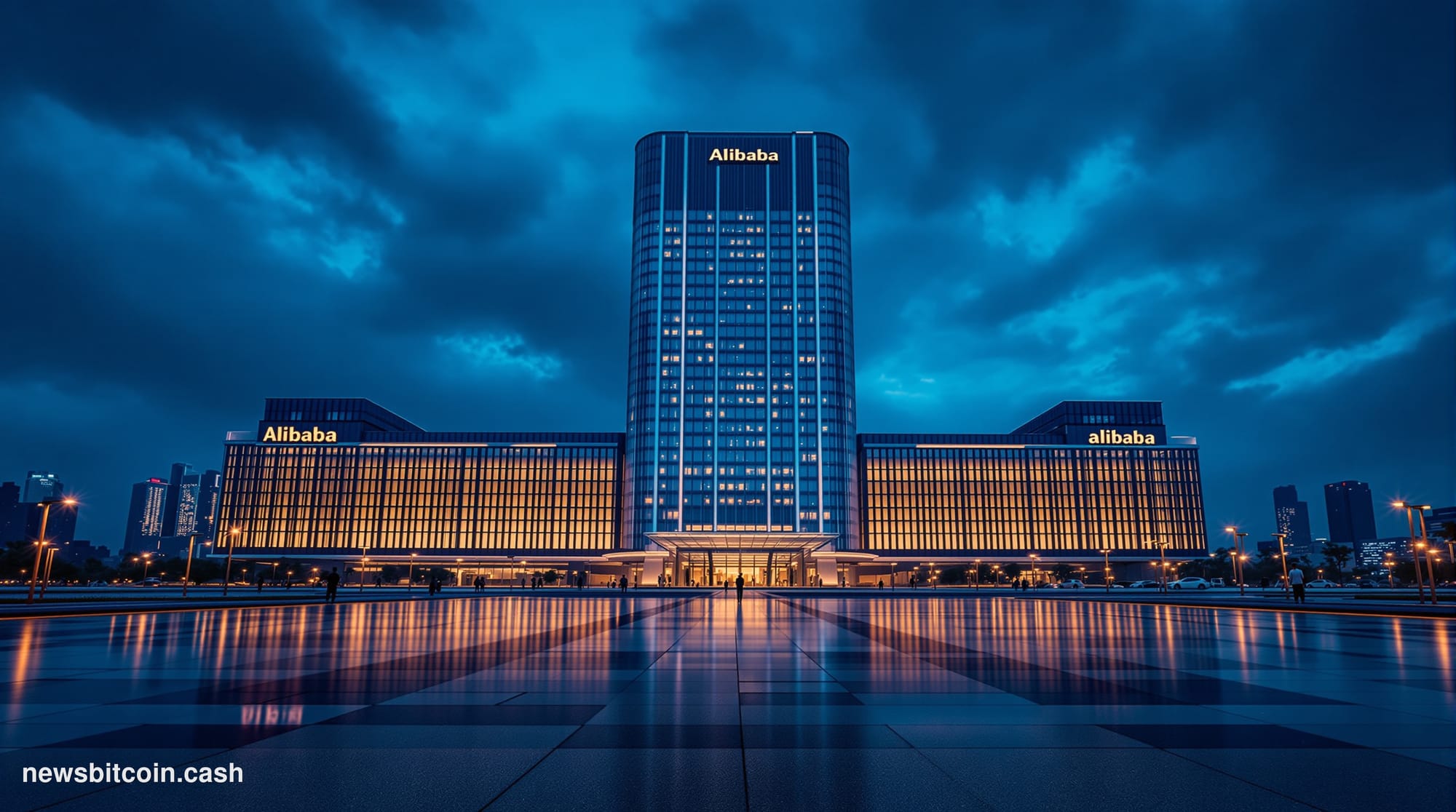
When a company the size of Alibaba Group Holding decides to stake its future on a single technology, the scale of the commitment matters as much as the direction. This week, the Chinese e-commerce and cloud computing giant announced what amounts to a record share sale — approximately $10 billion — with a declaration that leaves little room for ambiguity: every dollar of net proceeds will be funneled into full-stack artificial intelligence capabilities. The move signals not just a strategic pivot, but an existential one, as the competitive pressure building across global AI infrastructure reaches a point where hesitation is its own form of risk.
The mechanics of the deal are straightforward. Alibaba is offering 710 million ordinary shares priced at HK$112.70 each, representing a 3.6% discount to Friday's closing market price. Discounted share sales of this structure are a familiar tool for capital raises of this magnitude — the discount serves as an incentive for institutional investors to commit at speed and at scale. That Alibaba is absorbing that dilution cost rather than seeking alternative financing instruments speaks to urgency. When you need capital deployed fast and in volume, an equity offering at a modest haircut is often the most direct path.
What sets this particular raise apart from routine capital market activity is the categorical commitment attached to the proceeds. The company has not described a portfolio of investment priorities or a phased technology roadmap with AI as one line item among many. The stated intent is absolute: 100% of net proceeds into full-stack AI. In corporate finance terms, that kind of unambiguous language is rare. It tells the market — and competitors — exactly where Alibaba believes the next decade of value creation will be fought and won.
Full-stack AI is a deliberately expansive term. It encompasses everything from the silicon layer — custom chips and accelerator hardware — through the infrastructure stack of data centers and networking, up through foundational model development, training pipelines, inference optimization, and ultimately the application layer where AI capabilities are monetized in enterprise and consumer products. Building genuine full-stack competency requires sustained, coordinated capital deployment across all of those layers simultaneously. A $10 billion injection is a meaningful down payment on that ambition, though it will not be the last check Alibaba writes in this race.
The competitive context is important. Alibaba enters this phase of aggressive AI investment at a moment when the global technology industry has effectively bifurcated into those who control AI infrastructure at scale and those who depend on it. In the United States, hyperscalers have committed hundreds of billions of dollars cumulatively to AI infrastructure build-out. In China, Alibaba occupies a structurally significant position through its cloud computing division, Alibaba Cloud, which gives it both the data assets and the distribution architecture to make full-stack AI investment more than theoretical. This share sale is the financial expression of converting that structural advantage into a durable competitive position before the window narrows further.
For observers tracking the intersection of capital markets and emerging technology infrastructure — a cohort that increasingly includes the digital assets community — the Alibaba raise carries instructive signals. The willingness of one of Asia's largest technology companies to tap equity markets at scale, accepting dilution, to finance AI infrastructure mirrors a broader dynamic: the world's most consequential technology buildout of this decade is being financed not through debt instruments or organic cash flow alone, but through large-scale capital mobilization events. That pattern has implications for how capital is allocated globally, how cloud and AI infrastructure pricing evolves, and ultimately how decentralized alternatives position themselves against increasingly centralized AI infrastructure giants.
There is also a regulatory dimension worth watching. Alibaba operates in a domestic environment where state priorities and corporate strategy are not always independent variables. The Chinese government has made artificial intelligence a national strategic priority, and a $10 billion all-in AI commitment from one of the country's flagship technology companies aligns neatly with that national agenda. Whether that alignment is purely organic or reflects a degree of coordinated industrial policy is a question analysts will continue to probe, but the directional coherence between Alibaba's stated strategy and Beijing's technology ambitions is not coincidental.
What this means for the broader technology and digital infrastructure landscape is that the AI arms race has now entered a phase of record-scale capital mobilization. Alibaba's $10 billion share sale — the largest of its kind in the company's recent history — is a data point in a larger pattern of hyperscale investment that is reshaping where compute power lives, who controls it, and what it costs to access. For anyone building or investing at the infrastructure layer of the digital economy, from cloud to blockchain to decentralized compute networks, that pattern deserves close and sustained attention.
Written by the editorial team — independent journalism powered by Bitcoin News.